Quick answer
The best text to speech for academic papers is a reader that skips what you don't want to hear. Speechify lets you skip citations, brackets, parentheses, headers, footers, and URLs. Paper2Audio (iPhone) says it skips page numbers, footnotes, and citations automatically. Voice Dream skips PDF headers and footers on Apple devices. For a free option, Microsoft Edge reads PDFs aloud, though it reads everything. Test any app with a paper from your own field.
Our disclosure: oBook is our app, and we include it below with its limits for papers. Everything else comes from each company's own help pages and app store listings, checked in November 2026.
Key takeaways
- Citations, running headers, and footnotes are what make papers hard to listen to.
- Speechify has the most detailed skip settings; Paper2Audio is built specifically for papers.
- Edge and Acrobat Reader are free but read every bracket and page number.
- Two-column and scanned PDFs cause most reading-order problems, whatever app you use.
- Listening suits abstracts, introductions, and discussions; read methods and tables with your eyes.
Want to listen instead of read? Try reading along with oBook, free.
Try oBook freeWhy papers are harder to listen to than books
A novel is one stream of text. A paper is a page layout full of things that make sense to the eye but sound like noise:
- Citations like "[12]" or "(Smith et al., 2021)" in the middle of sentences.
- Running headers and footers with the journal name, page numbers, and DOI on every page.
- Two-column layouts, where a reader can jump across columns.
- Footnotes, figure captions, and tables dropped into the middle of a paragraph.
- Equations, which most voices read as a jumble of symbols.
- Scans of older papers with no real text at all.
A good reader for papers handles the first two automatically or lets you switch them off. Nothing handles equations and tables well yet, so plan to read those parts.
The best apps for academic papers
| Speechify | Paper2Audio | Voice Dream | Microsoft Edge | oBook | |
|---|---|---|---|---|---|
| Skips citations | Yes, if turned on | Says yes, automatically | Not advertised | No | Not advertised |
| Skips headers and footers | Yes, if turned on | Says it skips page numbers | Yes, automatically | No | Not advertised |
| Platforms | iOS, Android, Mac, Windows, web | iPhone | iPhone, iPad, Mac | Windows, Mac | iPhone, Android |
| Price | Free plan; Premium $139/yr | See App Store | Subscription after trial | Free | Free plan; Pro $49.99/yr |
| Best for | Heavy paper reading across devices | Papers on iPhone | Apple users who want offline voices | Free listening on a computer | Textbooks and long PDFs |
1. Speechify: best skip controls
Speechify lets you decide what to skip. In the web app, open the paper, choose More in the left toolbar, then Skip Content, and tick headers, footers, brackets, braces, citations, parentheses, and URLs, or choose Skip All. Stanford's accessibility office recommends the same steps to its students. Speechify also runs on phones, computers, and the web, so you can start a paper at your desk and finish it on a walk.
- Price: Free plan with limited voices; Premium is $29 a month or $139 a year.
- Watch out for: skipping depends on Speechify recognizing the citation style, so check a page or two of your first paper.
2. Paper2Audio: built for papers on iPhone
Paper2Audio is an iPhone app made for papers and PDFs. Its App Store listing says it skips clutter like page numbers, footnotes, and citations without you setting anything up. It's a good fit if you mostly listen on your phone and don't want to fiddle with settings. Check the App Store for current pricing.
3. Voice Dream: best on Apple devices
Voice Dream is a full-featured reader for iPhone, iPad, and Mac. Its listing says it skips PDF headers and footers automatically, and its voices work offline, which helps on flights and commutes. It doesn't advertise citation skipping, so expect to hear the brackets. A subscription is required after the free trial.
4. Microsoft Edge: the free option
Open the PDF in Edge and select Read aloud, or press Ctrl+Shift+U. It's free, quick, and good enough for a first pass. It reads everything on the page, though, including citations and page numbers. Adobe Acrobat Reader's Read Out Loud works similarly. Our guide to reading a PDF aloud covers both step by step.
5. oBook: for textbooks and book-length PDFs
oBook reads imported PDFs in natural AI voices, highlights the text as it goes, and keeps your place with chapter navigation and bookmarks. It doesn't advertise citation or header skipping, so it's a better fit for textbooks, monographs, and long reports than for citation-heavy journal articles. It's on iPhone and Android, with a free plan and oBook Pro at $49.99 a year.
How to test an app in five minutes
Pick a typical paper
Choose a two-column paper from your own field, with in-text citations and a header on every page.
Check the first page
Listen to the abstract and the first paragraphs of the introduction. Note whether you hear the journal header, the DOI, or citation brackets.
Jump to a page break
Skip to the end of a page with a footnote or figure. Good readers continue the sentence; weaker ones read the page number and caption in the middle.
Try your usual speed
Set the speed you'd actually use, often 1.25x to 1.5x, and see whether the voice stays clear.
Tip
If a paper reads in the wrong order in every app, the PDF probably has no reading order recorded. Download the publisher's version if you can, since it's often tagged better than a preprint or an old scan.
How to listen to papers well
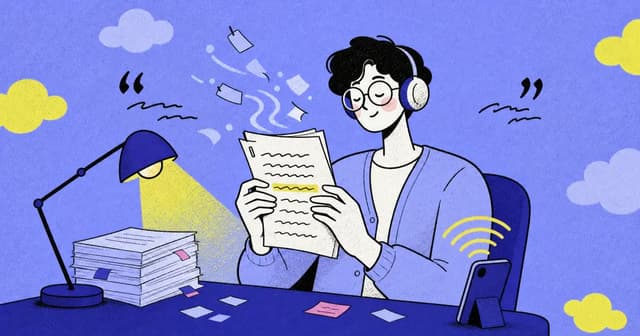
Listening is great for the parts of a paper that read like prose: the abstract, introduction, and discussion. It's a fast way to decide whether a paper is worth a close read, and to get through background reading on a commute.
Keep the PDF open for figures, tables, and equations, or read those sections yourself. If you're working in a second language, listening and reading at the same time can help with technical vocabulary. Our article on reading while listening covers what the research says about comprehension.
For more readers, including free plans and file support, see our guide to the best apps that read books to you.