

Quick answer
To build a daily reading habit, anchor a short reading session to a routine you already have, start with a time goal small enough to feel easy (five to ten minutes), and remove friction by keeping a book or audiobook ready to go. Consistency matters more than volume: reading ten minutes every day builds a stronger habit than one long session a week. You'll get a simple five-step plan below, plus what to do on the days it doesn't happen.
Why most reading goals don't survive a busy week
Most reading goals fail for the same reason most habits fail: they depend on finding free time, and busy weeks don't have any. "Read more this year" is a goal without a trigger, so it competes with everything else for the same unscheduled hour that usually loses to email, chores, or simply being tired.
Attaching a new behavior to an existing routine, so the routine itself becomes the reminder to act, instead of relying on memory or willpower.
A daily reading habit works the same way. It needs a fixed trigger, a low barrier to starting, and a way to keep going when your hands, eyes, or energy are already spoken for.
Key takeaways
- Attach reading to a trigger you already have, not to "free time."
- Start smaller than feels necessary — five to ten minutes is enough to begin.
- Track streaks, not pages, so the habit survives dense or difficult books.
- Audio removes the barriers that stop reading on busy or tired days.
- Missing a day occasionally does not undo the habit; missing it always does.
The five-step plan
Pick one fixed trigger
Choose a moment that happens every day no matter what — a commute, making coffee, or getting into bed — and decide that reading happens right after it.
Set a time goal, not a page goal
Ten minutes a day is a realistic starting point. A time goal doesn't punish you for reading something denser or slower than usual.
Remove the setup step
Keep your current book or audiobook already open and ready, so starting takes zero decisions. Friction at the start is the most common reason a habit doesn't happen.
Make it work with your hands and eyes busy
Add a listening option for days when your eyes are tired or your hands are occupied — cooking, walking, or commuting are all reading time if you can listen instead.
Track the streak, not the book
Log whether you read today, not how far you got. A visible streak is what keeps the habit going after the initial motivation fades.
Want to listen instead of read? Try reading along with oBook, free.
Try oBook freeReading, listening, or both
You don't have to choose one format forever. Different moments in a day call for different formats, and the habit is more durable when it can flex between them.
| Print or e-book | Audiobook only | Read + listen together | |
|---|---|---|---|
| Works with hands busy | No | Yes | Yes |
| Works with eyes tired | No | Yes | Yes |
| Helps retention | Yes | Yes | Yes, often more |
| Good for language learning | Some | Yes | Yes, best of both |
| Easy to start in under 10 seconds | Sometimes | Yes | Yes |
Tip
If you're building this habit alongside a busy schedule, protect the easiest version of it on your hardest days. Ten minutes of listening while making dinner still counts, and it keeps the streak alive.
How long before it actually feels automatic
Across 96 participants tracked daily for 12 weeks, the time it took a new daily behavior to become automatic ranged from 18 to 254 days, with a median of about 66 days. The study also found that missing a single day here and there did not meaningfully harm habit formation, as long as the behavior resumed.
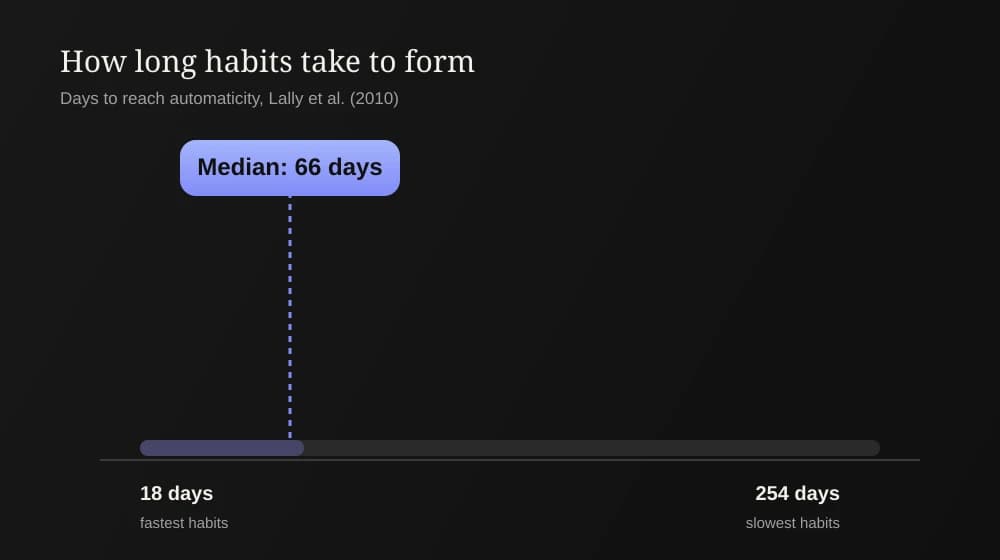
That range matters because it sets realistic expectations. If day nine still feels effortful, that's normal, not a sign the habit isn't working. Audiobooks are part of why this habit is easier to sustain today than it used to be — separate research from Pew found that audiobook listening in the U.S. has more than doubled since 2011, which suggests more people are finding formats that fit around their schedule rather than against it.
What to do when you miss a day
Missing a day is not the same as breaking the habit. Restart at the next trigger, not tomorrow's optimism. If you consistently miss the same trigger, the trigger is the problem — pick a more reliable one rather than trying harder at the same one.
Sources
The oBook Team
Reading habit research at oBook
Frequently asked questions
Research on habit formation found it takes a median of 66 days for a new behavior to become automatic, though it can range from about 18 to 254 days depending on the person and the behavior. Reading daily for two to three months is a realistic target before it starts to feel automatic.